
Emergency Water Treatment (2025): Store, Treat, Filter
When tap water becomes unsafe due to contamination, main breaks, storms, or treatment failures, households need a clear and verifiable process grounded in public-health standards. This Emergency Water Treatment (2025): Store, Treat, Filter guide explains the three critical layers of emergency water safety—Store, Treat, Filter—with methods validated by the Centers for Disease Control and Prevention (CDC), Environmental Protection Agency (EPA), and NSF/ANSI drinking-water performance standards.
This article supports the Praeparium Emergency Water Preparedness Series, including Emergency Water Preparedness , PFAS & Lead Filters, Best Stackable Water Cubes, 55-Gallon Drum Setup, and Bathtub Water Bladders.
Affiliate LInks: We fund this work through affiliate links, which are presented only after the facts—they never influence our methodology. Our goal is to give you the clarity to move from “What now?” to “Done.”
- Store Water: Build a Known-Safe Reserve
- Clarify First: Improve Turbidity for Reliable Treatment
- Boiling: Maximum Microbe Kill for Most Households
- Bleach Dosing: Fast, Scalable Disinfection When Fuel Is Tight
- Where Tablets Earn Their Keep: Packable, Predictable Protection
- Certified Filters: Match Water Treatment to Verified Capabilities
- Decision Framework : Match Your Threat, Timeframe, and Situation to the Right Treatment
- Urban Apartment Prepper: What Works When You’re Living Six Floors Up
- AquaTru Carafe Countertop Water Purifier
- Bluevua UV Reverse Osmosis System Countertop Water Filter
- Suburban Household Prepper: The Space to Store and the Power to Filter
- Waterdrop X12 Reverse Osmosis System
- Frequently Asked Questions: Clear Up Common Water Treatment Mistakes
- Related Praeparium Water Articles
- Author note — Why you can trust our guidance
- Sources
Store Water: Build a Known-Safe Reserve
Storing known-safe water is the highest-certainty layer of household resilience because it bypasses the risks of treatment errors, chemical contaminants, or equipment failure. CDC and FEMA guidance recommends at least 1 gallon per person per day for 3 days, with additional amounts for children, older adults, sick family members, and pets (CDC 2024). This baseline represents the minimum requirement; actual household usage—especially for cooking and hygiene—often exceeds this level during disruptions.
A robust supply must align with your time ladder. For 72 hours, commercially bottled water or sanitized, food-grade containers filled before an event are sufficient. If aiming for two weeks, households should mix bulk options such as 7-gallon stackable cubes or a 55-gallon drum—with portable containers for quick access. For 30 days or longer, storage alone becomes impractical, and households integrate filtration or disinfection methods.
The storage layer you choose will depend on your situation. Urban apartment preppers benefit from modular water cubes because they balance weight and floor loading. Suburban homes can safely place 55-gallon drums on garage slabs. Families with children need containers that are easy to pour without spills. Mobile/evacuation users require lightweight bladders and bottles.
Storage does not remove chemical or microbial hazards; it merely preserves previously safe water. Therefore, maintenance habits matter. Stored municipal water should be rotated every 6–12 months to maintain quality, as recommended in CDC storage guidance. Bottled water should be kept away from heat and direct sunlight to prevent packaging degradation. For households using bathtub bladders during boil-water advisories or incoming storms, the water is not purified by the liner—it must still be treated before consumption. These practices ensure that stored water remains the most reliable and least labor-intensive component of emergency readiness.
Clarify First: Improve Turbidity for Reliable Treatment
Clarifying water is a required precursor for effective chemical or thermal treatment because particles shield microorganisms from disinfectants. The EPA’s emergency disinfection procedures specify that cloudy, sediment-laden, or colored water should be settled and pre-filtered before boiling, chlorination, or tablet use (EPA 2024). This step increases reliability and lowers chemical demand.
The clarification process is simple: allow water to stand undisturbed until solids settle, then decant the clearer portion. If settling alone is insufficient, households can pour water through a clean cloth, paper towel, or coffee filter. This does not purify the water, but it improves the performance of boiling, bleach, chlorine dioxide, or micro-filters. Pre-filtering is also essential when using portable squeeze filters or gravity bags because sediment accelerates clogging.
Clarified water produces more predictable dosing results, especially for bleach disinfection, which requires accurate contact times and concentrations. If you have bugged otd or evacuated and need to source water from streams or ditches, clarifying reduces treatment time and conserves chemical tablets. Off-grid users facing turbid well or surface water should use clarification to prevent early failure of mechanical filters. Urban apartment preppers may also encounter cloudy water during boil-water advisories when distribution systems lose pressure.
Clarification is also advisable before using any carbon-based filter. Chlorine can bind to carbon, and high turbidity can reduce the filter’s effectiveness. For households using NSF-certified filters during contamination events, pre-clarification ensures that the filter operates within its tested conditions. This is especially important when using devices such as the Sawyer Squeeze or Sawyer Mini, which are absolute 0.1-micron microfilters. These remove bacteria and protozoa but can clog quickly without clarification.
In short, clarification increases the reliability of every downstream method. It should be treated as a non-optional step whenever water is visibly cloudy or when the source is uncertain. For a broader discussion of storage methods that support dependable clarification workflows, see Best Stackable Water Cubes and 55-Gallon Drum Setup.
Boiling: Maximum Microbe Kill for Most Households
Boiling remains the most authoritative and universally recommended method for eliminating biological contaminants in emergency drinking water. The CDC instructs households to bring clear water to a rolling boil for one full minute, or three minutes at elevations above 6,500 ft, to inactivate viruses, bacteria, and protozoa (CDC 2024). Boiling is highly reliable because it does not depend on precise chemical dosing, water temperature measurement, or equipment calibration.
Boiling integrates differently at each stage of the time ladder. For 72-hour readiness, it is the primary treatment method because households typically retain access to stoves, grills, or portable burners. For 2-week disruptions, boiling remains the safest technique when fuel is available, but fuel consumption becomes a constraint. For 30-day+ planning, boiling continues to serve as a fallback method but is only sustainable when households maintain large fuel reserves or supplement it with chemical or filtration methods.
Suburban households with backup stoves or propane stockpiles can maintain boiling over longer periods. Families with infants, toddlers, or immunocompromised members benefit from boiling because it offers the highest microbial certainty. It still pays to understand other water treatment options and have a backupif boiling isnt available . Urban apartment preppers may lose access to stoves during power outages and require alternative methods, such as tablets or certified filters. Mobile and evacuation preppers rarely have stable heat sources and rely more heavily on tablets or portable filters.
It is important to remember boiling does not remove chemical hazards, including fuel contamination, solvents, lead, or PFAS. For these risks, the CDC advises switching to bottled water or certified filters rather than boiling (CDC 2024). If chemical contamination is suspected or stated in a boil-water advisory, boiling should not be used. In those situations boiling could concentrate the contamination.
Boiled water must cool naturally and be stored in sanitized containers to prevent re-contamination. Containers must have tight lids, and preppers should avoid touching the interior surfaces after sanitizing.
Boiling remains a foundational method within the Praeparium Store-Treat-Filter model and forms the backbone of safety during short-term crises.
Bleach Dosing: Fast, Scalable Disinfection When Fuel Is Tight
Household bleach is an accessible and validated emergency water disinfectant when used exactly according to EPA and CDC guidance. The active ingredient, sodium hypochlorite (NaOCl), neutralizes most pathogens on contact. Bleach is uniquely scalable: it treats large volumes without requiring heat, making it essential during prolonged outages where fuel or power is limited.
Bleach concentration varies across retail products, but emergency procedures rely on two common strengths: 6% and 8.25% sodium hypochlorite. The EPA emergency disinfection table specifies the following dosing (EPA 2024):
| Volume | 6% Bleach | 8.25% Bleach | Contact Time |
|---|---|---|---|
| 1 quart / 1 L | 2 drops | 2 drops | ≥ 30 min |
| 1 gallon | 8 drops (apprx 0.5 mL) | 6 drops (approx 0.5 mL) | ≥ 30 min |
| 5 gallons | ½ tsp (approx 2.5 mL) | ⅜ tsp (approx 1.9 mL) | ≥ 30 min |
If water is cloudy or cold, users should pre-filter and double the dose, then allow the full contact time. After treatment, water should have a faint chlorine smell. If there is no smell, another dose is required followed by 15 minutes of wait time. This residual indicates adequate disinfection.
Suburban households with larger storage volumes depend on bleach to maintain water safety in 5-gallon and 55-gallon containers. Mobile preppers can carry a small vial of concentrated bleach or chlorine drops as a backup to tablets. Urban Apartment preppers can treat sink-filled water during advisories. Families with children should be aware of taste concerns, particularly when double dosing. Aeration by tipping between containers can reduce odor, or an NSF 42 certified filter may improve taste and odor.
Bleach’s limitations must be emphasized. It does not inactivate Cryptosporidium, a chlorine-resistant protozoan (CDC 2024). It also does not remove chemical contaminants, including fuels, industrial solvents, lead, or PFAS. In events involving chemical contamination, preppers must rely on bottled water, previously stored safe water, or NSF-certified filtration systems rather than bleach or boiling. Bleach also has a limited shelf life—typically six months to one year depending on storage conditions—so households should rotate supplies regularly.
The bleach method remains indispensable for long-duration, low-fuel scenarios.
Where Tablets Earn Their Keep: Packable, Predictable Protection
When you’re mobile—evacuating, hiking, or traveling—chemical tablets are your pocket-sized backup plan. They make small volumes safe without fire, electricity, or measuring gear. But not all tablets are equal.
The Crypto Caveat: Why we recommend Chlorine Dioxide
Iodine and standard chlorine tablets kill bacteria and viruses but do not reliably inactivate Cryptosporidium. Chlorine Dioxide, however, does—if used exactly as directed (CDC 2024). It requires a four-hour contact time at ~21 °C / 70 °F, doubled in cold water. Chlorine dioxide also leaves less taste and odor than iodine, making it ideal for sustained use (CDC 2024; EPA 2024).
Chlorine Dioxide Tablets: Portable Treatment for Evacuation
Chlorine dioxide tablets provide a compact and dependable chemical treatment option for small volumes of water, especially during evacuation or when access to heat and bulk disinfectants is restricted. Unlike iodine or standard chlorine tablets, chlorine dioxide is effective against Cryptosporidium when used exactly as directed, making it one of the most universally capable chemical treatments available to households (CDC 2024).
Manufacturer instructions—aligned with CDC expectations—require a four-hour contact time at approximately 21°C / 70°F. Cold water requires extended treatment times. The Katadyn Micropur MP1 or the Aquatabs 49mg Water Purification Tablets (100 Pack) formulations are specifically designed for predictable performance, with each tablet treating approximately 1 liter of water. Tablets work best with clarified water because sediment interferes with oxidation.
Mobile and evacuation-oriented preppers rely heavily on tablets because they treat water passively while users travel, pack, or rest. Urban apartment preppers benefit from tablets when boiling is impossible during grid outages. Suburban homeowners may use tablets as a backup when fuel runs low or when Reverse Osmosis systems cannot operate due to power loss. Off-grid users who frequently encounter cold or turbid water benefit from combining tablets with pre-filtering and mechanical filtration.
The tablets’ portability, long shelf life, and Cryptosporidium performance make them essential in every go-bag, vehicle kit, and home preparedness plan. They serve as the primary mobile treatment option in the Praeparium time ladder and as a credible fallback method for households facing prolonged outages. Tablets also pair effectively with squeeze filters such as the Sawyer Mini and Sawyer Squeeze, which remove sediment, bacteria, and protozoa but do not address viruses or certain parasites without chemical backup.
Pro Tip while camping: start the purification process during camp breakdown. Let the chemistry do its work while you handle everything else. During the California wildfires, an evacuee posted that chlorine dioxide tabs ‘quietly saved the day.’ They dropped a tablet into each bottle before breaking camp and had safe water waiting at every stop. ‘It bought us four hours of safety while we handled everything else,’ they said
Tablets: The Volume and Chemical Drawbacks
While chlorine dioxide tablets are versatile, they are not designed for bulk disinfection. Treating large volumes quickly becomes impractical, and the four-hour wait time makes tablets unsuitable for high-throughput needs unless users maintain a steady rotation of bottles. Tablets also do not remove chemical contaminants. They complement, but do not replace, certified filters, which may be required for PFAS, lead, VOCs, and other chemical risk profiles.
Certified Filters: Match Water Treatment to Verified Capabilities
Filters are widely marketed, but only NSF/ANSI-certified devices provide verifiable claims tied to specific contaminant reductions. Preppers match filters to risks based on certifications rather than brand names or pore-size alone. The NSF certification system provides the authoritative structure:
| Certification | Protects Against | Typical Device Type |
|---|---|---|
| NSF 42 | Taste, odor, chlorine | Pitcher filters |
| NSF 53 | Lead, cysts, specified Volatile Organic Compounds (VOCs), specified chemicals | Under-sink / countertop |
| NSF 58 | multiple contaminants | Reverse osmosis |
| NSF 401 | “Emerging” contaminants (pharma, PFAS subset) | Specialty carbon filters |
| NSF P231 | Bacteria, viruses, protozoa (microbiological purifiers) | Advanced field purifiers |
Claims such as “tested to NSF standards” do not indicate certification. A certified device requires verification of the exact model’s performance and must appear in the NSF database (NSF 2024). For PFAS and lead, preppers should on NSF 53 or NSF 58 listings. For viral and protozoan risk from surface or untreated water, only NSF P231 purifiers are validated.
Urban apartment preppers can benefit from countertop Reverse Osmosis systems that require no plumbing. Suburban homeowners can plumb in under-sink Reverse Osmosis systems for long-term chemical protection. Mobile users rely on squeeze filters paired with chemical treatment. Off-grid users may depend on P231-certified purifiers due to surface-water exposure.
Filters do have limitations. Mechanical filters like the Sawyer Squeeze and Mini do not remove viruses or chemical contaminants and must be paired with boiling or chlorine dioxide. Reverse Osmosis systems require power and may be unusable during outages unless households have alternative energy sources. Carbon filters eventually exhaust and must be replaced on schedule or the filters will not perform.
The inclusion of certified filters in every long-duration preparedness plan ensures that households can safely address risks that boiling and bleach cannot resolve.
Decision Framework : Match Your Threat, Timeframe, and Situation to the Right Treatment
Preppers reduce decision complexity by using a structured selection matrix that matches the contaminant type,the timeframe they are planning for, and their situation.
Emergencies differ in three key ways: what contaminated the water, how long the disruption will last, and where you’re trying to ride it out. The safest approach is to start with the risk (microbial vs chemical), then apply the right method for your timeframe, and finally match the method to what’s realistic in your living situation.
This table is designed to help readers choose the correct tool for them without overbuying gear or relying on a method that cannot handle the contaminant.
| Contaminant Type | Timeframe Needed | Situation | Recommended Method & Product |
|---|
| Microbial Only (viruses, bacteria, protozoa) | The first 72 Hours | Urban apartment (no stove), Mobile evac | Chlorine dioxide tablets (Katadyn Micropur MP1 or Aquatabs 49mg Water Purification Tablets 100 Pack) — reliable biological kill without heat; works during outages. |
| Microbial Only | The first 72 Hours | Suburban home, Families with heat source | Boiling (CDC 1–3 min) — highest reliability for households that can heat water. Use Sawyer Mini/Squeeze for pre-filtering if cloudy. |
| Microbial + Turbidity (cloudy water, sediment + pathogens) | 2 Weeks | Off-grid / rural, Mobile, Suburban | MSR Guardian (NSF P231) — handles viruses, bacteria, protozoa, and sediment-heavy sources; no power needed. |
| Chemical Contaminants (lead, PFAS, fuel-like odors, solvents, VOCs) | 72 Hours | Any persona | Do NOT boil or bleach. Use stored or bottled water only per CDC/EPA. |
| Chemical Contaminants | 2 Weeks | Urban apartment, Families | AquaTru Reverse Osmosis or Bluevua countertop Reverse Osmosis remove PFAS, lead, VOCs; ideal when municipal water is questionable. |
| Chemical Contaminants | 30 Days+ | Suburban homes with stable power | Waterdrop X12 (NSF 58/372) — long-term solution for PFAS/lead/VOCs with high flow for daily cooking and drinking. |
| Mixed Risks (biological + chemical uncertainty) | Any timeframe | Apartment, Suburban | Layered approach: Pre-filter → boil/treat → RO. Use Squeeze/Mini for sediment, MP1 for disinfection, AquaTru/Waterdrop for chemistry. |
| Uncertain Source (surface water, storm runoff, creek water) | 72h – 2w | Mobile, Off-grid | Sawyer Squeeze for sediment + protozoa + bacteria. Combine with chlorine dioxide for viruses/Crypto. |
| Bulk Storage Safety (drums/cubes) | 2w – 30d | Suburban, Families | Bleach dosing (EPA guidance) to maintain stored water safety. Not for chemical contamination. |
This framework ensures households do not rely on a single method. For example, boiling covers microbes but not chemicals, while RO covers chemicals but requires power. Chlorine dioxide covers Crypto and viruses but is slow. A layered approach, combining storage, clarification, treatment, and filtration, ensures reliable safety across durations and scenarios.
For storage, refer to Best Stackable Water Cubes and 55-Gallon Drum Setup. For PFAS and lead issues see PFAS & Lead Filters.
Urban Apartment Prepper: What Works When You’re Living Six Floors Up
For preppers in urban apartments, water emergencies unfold differently.
You may not have a gas stove, you can’t store a 55-gallon drum in the hallway, and your building’s plumbing can act like a single point of failure. What works best here is a kit that respects limited space and unreliable power. Most preppers in high-rises settle on a simple pattern: keep a few 3–7 gallon cubes for short disruptions, rely on chlorine dioxide tablets for the times when boiling isn’t an option, and use a countertop Reverse Osmosis unit like the AquaTru or Blueva whenever the tap tastes “off” or local authorities issue a chemical advisory. It’s a clean, quiet setup that fits in a cupboard and doesn’t upset the neighbors. Practical resilience tailored to dense living.
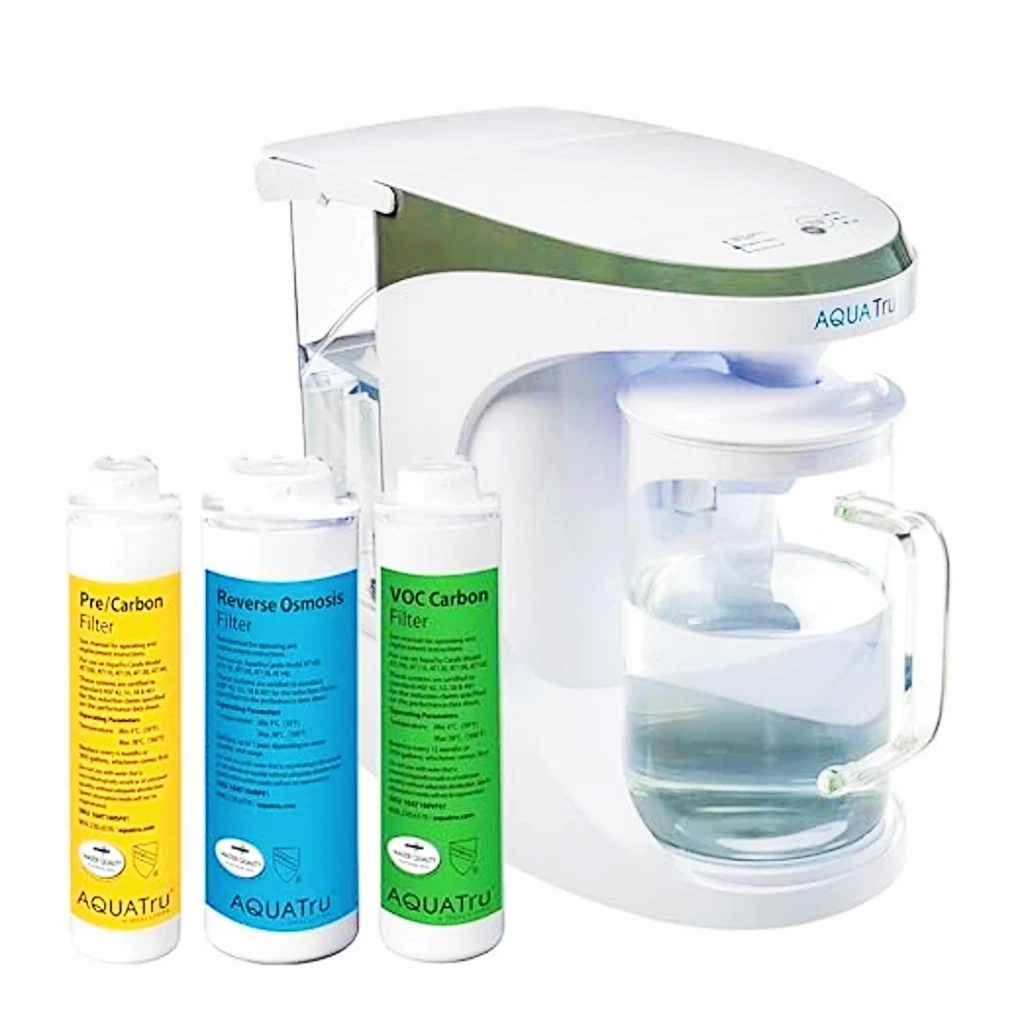
AquaTru Carafe Countertop Water Purifier
This countertop water purifier is IAMPO certified to NSF standards, removing 84 contaminants including PFOA/PFOS, lead, and microplastics. Its 4-stage reverse osmosis filtration ensures pure, great-tasting water, collected in a 64oz glass carafe. Compact and efficient, it’s an eco-friendly alternative—each filter set replaces 4,500 plastic bottles. Made with BPA-free materials, its filters are long-lasting (6 months to 2 years) and feature tool-free replacement for simple maintenance, providing families with a cost-effective and reliable source of clean drinking water.
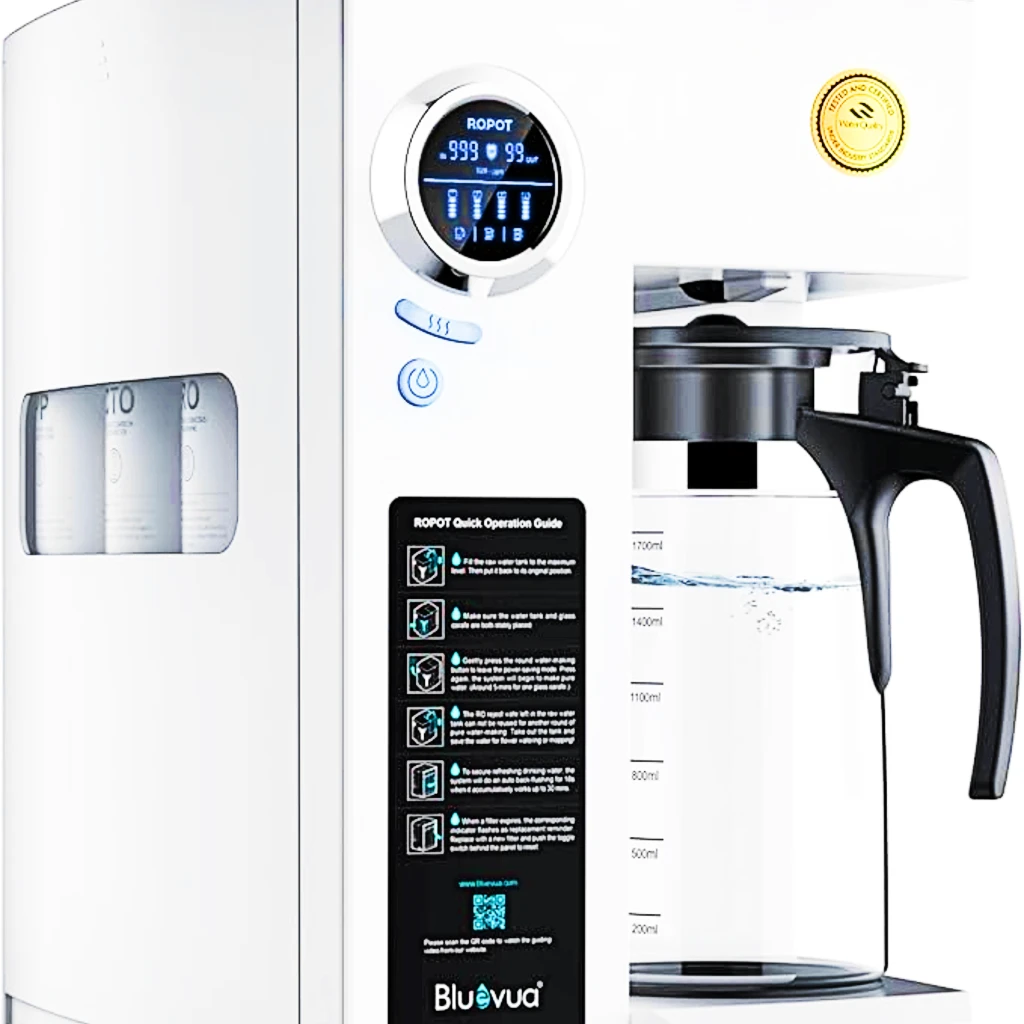
Bluevua UV Reverse Osmosis System Countertop Water Filter
The Bluevua UV is a countertop reverse osmosis system requiring no installation. Its 6-stage process, including a 0.0001μm RO membrane and UV light, is WQA certified to reduce lead, PFAS, and other contaminants, while a remineralization filter adds healthy minerals. It features a glass carafe to prevent plastic pollution, a filter life monitor, and an eco-friendly 2:1 pure-to-drain ratio. With filters lasting 1-2 years, it provides a sustainable, portable solution for producing high-quality, great-tasting drinking water directly from your countertop.
Suburban Household Prepper: The Space to Store and the Power to Filter
Suburban homes have one major advantage in water preparedness: room to work with. Garages, sheds, ground-floor storage, and stable kitchen plumbing open the door to solutions that are impossible in a small apartment or during evacuation. Most families in this setting build a layered approach: a couple of sturdy cubes or a drum for basic security, a bottle of unscented bleach for maintenance, and an under-sink Reverse Osmosis system like the Waterdrop G3P800 for day-to-day chemical resilience. When outages hit, the storage covers the gap; when advisories hit, the RO becomes the first line of defense. It’s a comfortable, reliable rhythm that matches the pace of home life.
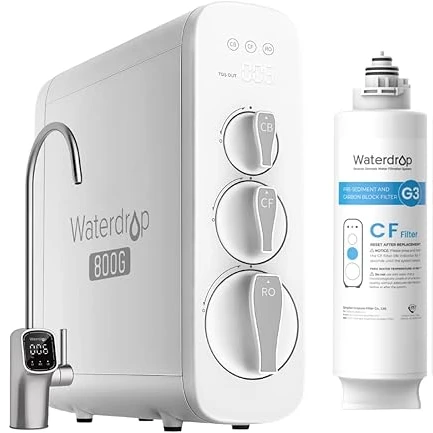
Waterdrop X12 Reverse Osmosis System
This under-sink reverse osmosis system is IAPMO R&T certified to NSF/ANSI standards for rigorous purification. Its 1200 gallons per day, tankless design provides fast, high-volume family use. The 11-stage filtration, including a 0.0001μm RO membrane, is tested to reduce PFAS, lead, chlorine, and more. It features a smart faucet showing total dissolved solids and filter life, and an alkaline mineral filter to adjust pH. With a 3:1 pure-to-drain ratio and 24-month filter life, it offers an efficient, eco-conscious water solution for healthy, great-tasting hydration directly from your tap.
Your Quick-Reference Treatment Guide
STEP 1: CLARIFY
If water is cloudy, let it settle. Pour gently through a clean cloth, paper towel, or coffee filter. This removes sediment so your disinfectant can work (EPA 2024).
STEP 2: DISINFECT (Choose One)
BOIL — The Go-To for Certainty
When: You have heat available.
How: Rolling boil 1 min (3 min > 6,500 ft).
Covers: Viruses, bacteria, parasites (CDC 2024).
BLEACH — The Tool for Volume
When: Fuel is limitedor you are treating larger volumes.
How: 8 drops 6 % or 6 drops 8.25 % per gallon; wait 30 min; check for a faint chlorine smell.
Covers: Bacteria, most viruses (EPA 2024).
CHLORINE DIOXIDE TABLETS
When: Mobile or power-out conditions.
How: Label-specific dose; 4-hour contact time at room temperature (longer if cold).
Covers: Bacteria, viruses, Cryptosporidium (CDC 2024).
CERTIFIED FILTER — The All-in-One Solution
When: Facing chemical risks or needing instant purification.
How: Use a system certified to NSF P231 (microbes) or NSF/ANSI 53 or 58 for chemicals (NSF 2024).
STEP 3: STORE SECURELY
Pour treated water into clean, sanitized containers. Seal tightly, label with date, and store in a cool, dark place (CDC 2024).
Frequently Asked Questions: Clear Up Common Water Treatment Mistakes
Does boiling remove PFAS or fuel?
No. Boiling targets microbes only. For chemical contamination, follow official advisories and use certified filtration (CDC 2024).
What’s the bleach dose per gallon—and how do I know it worked?
8 drops 6 % or 6 drops 8.25 %; wait 30 min. A faint chlorine smell means safe; no smell, dose again (EPA 2024).
Which tablets kill Cryptosporidium?
Only chlorine dioxide tablets or two-part drops, used exactly as labeled for 4 hours at room temperature (CDC 2024).
Can I filter first and then bleach the water?
Yes—filter first to remove sediment, then bleach. Never bleach before a carbon filter; chlorine can damage media (EPA 2024).
Are pitcher filters safe in emergencies?
No. They’re for taste and minor metals in treated tap water, not microbial safety (NSF 2024).
How much water should I store?
At least 1 gallon per person per day for 3 days. See Building a 72-Hour Water Reserve for space-efficient storage plans.
Related Praeparium Water Articles
55-Gallon Drum Setup (2025): Safe Bulk Storage for Households
PFAS & Lead: Choosing Certified Filters
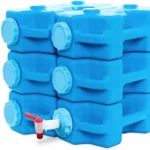
Best Stackable Water Cubes for Small Spaces (2025)
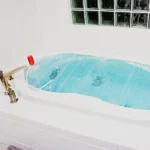
Bathtub Water Bladders for Short-Notice Events (2025)
Emergency Water Preparedness (2025)

Author note — Why you can trust our guidance
Praeparium’s Water Preparedness Editors bring together technical research, field experience, and standards-based evaluation to deliver clear, practical, and trustworthy guidance. Our team reviews water storage containers, filtration systems, chemical treatments, and emergency protocols using authoritative sources including CDC, EPA, FEMA, WHO, and NSF/ANSI performance standards.
We focus on real-world usability: how much water households actually need, how containers perform under long-term storage, how filters behave across microplastics and protozoa, and how treatment options compare under stress conditions. Recommendations are selected independently; we do not accept payment, samples, or placement fees from manufacturers. Every pick must meet transparent criteria for safety, reliability, and value.
Praeparium’s water editors are committed to responsible preparedness: mainstream, non-alarmist, evidence-led, and tailored to help families build resilience one safe step at a time.
Sources
Centers for Disease Control and Prevention (CDC). 2024. “How to Make Water Safe in an Emergency.” Centers for Disease Control and Prevention. https://www.cdc.gov/water-emergency/about/index.html.
— — —. 2024. “Boil Water Advisory.” Centers for Disease Control and Prevention. https://www.cdc.gov/natural-disasters/psa-toolkit/boil-water-advisory.html.
Environmental Protection Agency (EPA). 2024. “Emergency Disinfection of Drinking Water.” United States Environmental Protection Agency. https://www.epa.gov/your-drinking-water/emergency-disinfection-drinking-water.
National Sanitation Foundation (NSF). 2024. “Standards for Water Treatment Systems.” NSF International. https://www.nsf.org/consumer-resources/articles/standards-water-treatment-systems.
— — —. 2024. “NSF P231 Microbiological Water Purifiers: Guide Protocol.” NSF International. https://www.nsf.org.
Pingback: 55-Gallon Drum Setup (2025): Safe Bulk Storage for Households - praeparium.com